
Customization Guide
Domain Service Customization
The FS-CD Adapter provides domain services in module de.faktorzehn.fscd-adapter:fscd-adapter-business:
| Service Interface | Purpose |
|---|---|
|
Post financial postings to FS-CD |
|
Read account balance information |
|
Create and read SEPA mandates |
|
Read document information |
|
Read dunning information |
|
Create, update, and read insurance objects |
|
Create, update, delete, and read business locks |
|
Change the policyholder of a policy |
Each service interface has a default JCo-based implementation auto-configured by module de.faktorzehn.fscd-adapter:fscd-adapter-autoconfigure.
Service Architecture
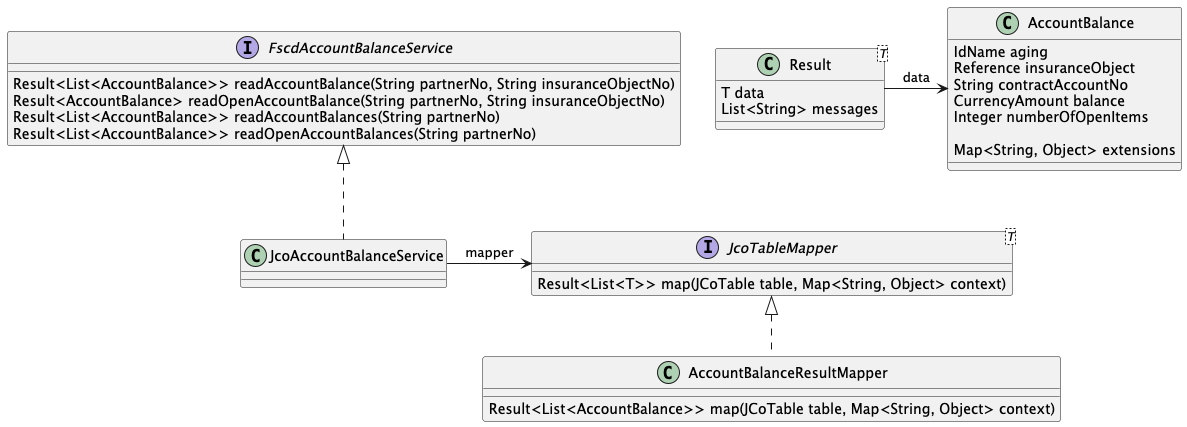
The following is a class diagram showing the interfaces and classes involved in a service that reads data from FS-CD, using the account balance service as an example.
-
Service Interface: Defines the service contract (e.g., reading account balances for a partner and insurance object number).
-
Service Implementation: Retrieves or processes data using JCo (e.g., fetching account balance data from FS-CD).
-
Mapper Interface: Defines the generic mapping function from
JCoTableto result type. -
Mapper Implementation: Maps
JCoTabledata toResult<List<T>>(e.g.,Result<List<AccountBalance>>).
For services that write data to FS-CD, such as the posting service, the architecture is similar but uses a different mapper interface:
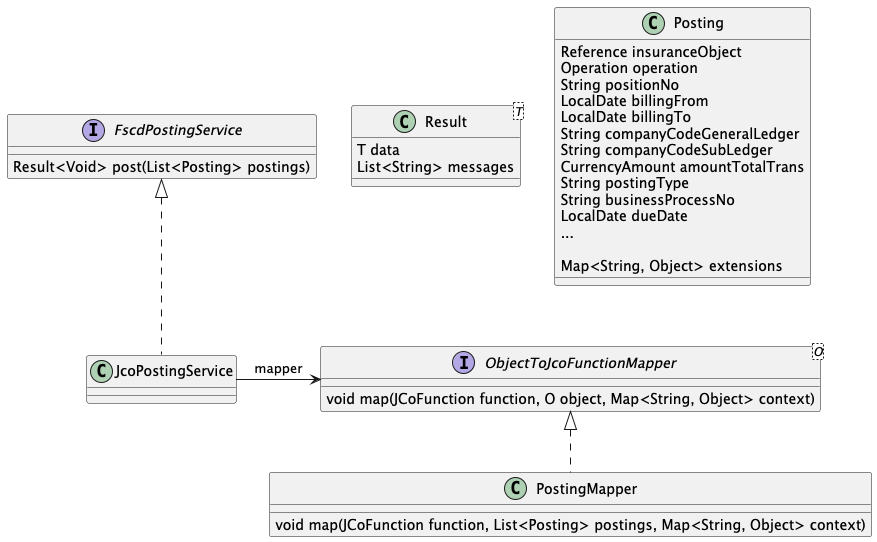
The key difference is the ObjectToJcoFunctionMapper interface and its PostingMapper implementation.
This mapper converts input data (e.g., a list of postings) to JCo function parameters.
The mapper’s map(JCoFunction, O, Map) method takes JCoFunction as a parameter for this reason.
The diagrams are simplified representations.
For the complete implementation details, refer to the source code in module fscd-adapter-business.
|
Customization Approaches
The services can be customized to accommodate project-specific requirements.
| Approach | Use When | Complexity |
|---|---|---|
Configuration Properties |
Using custom SAP function modules with compatible signatures |
Low |
Custom Mapper |
Need to handle additional RFC parameters or custom field mappings |
Medium |
Replace Service |
Need to fundamentally change service behavior or use different technology (e.g., SOAP instead of JCo) |
High |
Configure Custom Function Modules
To use custom SAP function modules (e.g., Z-functions) with compatible signatures, configure the function module name via Spring properties.
Example: Custom function module for reading account balances
fscd-adapter:
  jco:
    functions:
      read-account-balances: Z_CUSTOM_FSCD_BALANCE
See JcoFunctionProperties for the full list of configurable function modules.
Default function module names are defined as constants in the respective service implementation classes.
|
Configure No-Data Fields for Insurance Object Updates
On update, certain insurance object fields must be set to "/" to prevent SAP FS-CD from updating them.
These fields are configurable via properties.
fscd-adapter:
  insurance-object-mapper:
    no-data-on-update:
      header:                (1)
        - INSOBJECTTYP
        - VALDT
      insurance-object:      (2)
        - INSOBEZ
      partner:               (3)
        - MVARI
- IS_COVAR| 1 | IS_HEADER structure fields set to "/" on update |
| 2 | IS_IOB structure fields set to "/" on update |
| 3 | IS_IOBPAR structure fields set to "/" on update |
See InsuranceObjectMapperProperties for default values.
Business Lock Type Configuration
The business lock types available in the web application to create business locks can be configured as follows.
fscd-adapter:
  jco:
available-business-lock-types: 1,2,3,9 (1)| 1 | Comma-separated list of allowed business lock type IDs (default: 1,2,3,9). The corresponding texts are retrieved from the configured domain value texts. |
Customize RFC Parameters & Calls
To handle custom SAP fields or parameters, replace the mapper implementations used by a service using Bean Replacement.
Domain objects provide a Map<String, Object> extensions attribute for arbitrary data.
Custom mappers can use this to:
-
Transfer custom fields between RFCs and domain objects
-
Pass custom data through REST APIs to/from SAP FS-CD
Example: Read Custom RFC Field into Extensions (Read-Side Mapper)
The following example shows a custom AccountBalanceResultMapper that reads a non-standard RFC field and stores it in AccountBalance.extensions:
@Component
public class MyAccountBalanceResultMapper implements JcoTableMapper<AccountBalance> {

    @Override
    public Result<List<AccountBalance>> map(JCoTable table) {
        var result = new ArrayList<AccountBalance>();
        for (var row : JcoTableIterable.iterate(table)) {
            var read = new JcoRecordReader(row);
            var balance = AccountBalance.builder()
                    // ... standard field mappings ...
                    .build();
            balance.getExtensions().put("myCustomField", read.string("Z_CUSTOM_FIELD"));
            result.add(balance);
        }
        return Result.success(result);
    }
}
Example: Write Extensions Field to RFC (Write-Side Mapper)
The following example shows a custom PostingMapper that reads a value from Posting.extensions and passes it as a custom RFC parameter:
@Component
public class MyPostingMapper implements ObjectToJcoFunctionMapper<List<Posting>> {

    @Override
    public void map(JCoFunction function, List<Posting> postings, Map<String, Object> context) {
        var table = function.getTableParameterList().getTable("IT_POSTINGS");
        for (var posting : postings) {
            table.appendRow();
            var writer = new JcoRecordWriter(table);
            // ... standard field mappings ...
            var customValue = (String) posting.getExtensions().getOrDefault("myCustomField", "");
            writer.string("Z_CUSTOM_FIELD", customValue);
        }
    }
}
Replace a Service Implementation
To fundamentally change service behavior or use different technology (e.g., SOAP instead of JCo), replace the entire service implementation using Bean Replacement.